

Hey there! As a proud supplier of Gasoline Engine Trainers, I'm super stoked to dive into the exhaust system designs of these amazing pieces of equipment. So, let's get down to it!
First off, why do we even care about the exhaust system in a gasoline engine trainer? Well, it's not just about getting rid of the waste gases. A well - designed exhaust system can have a huge impact on the engine's performance, efficiency, and even the overall learning experience for students.
Basic Components of Exhaust Systems in Gasoline Engine Trainers
The exhaust system in a gasoline engine trainer typically consists of several key components. Starting from the engine, we've got the exhaust manifold. This part is connected to the engine cylinders and its job is to collect the exhaust gases from each cylinder and funnel them into one pipe. Think of it like a traffic coordinator, making sure all the exhaust gases flow smoothly out of the engine.
Next up is the catalytic converter. This is a real game - changer. It helps to reduce harmful emissions by converting pollutants like carbon monoxide, hydrocarbons, and nitrogen oxides into less harmful substances like carbon dioxide, water vapor, and nitrogen. In our training equipment, it's a great teaching tool to show students how we can make engines more environmentally friendly.
Then there's the muffler. The muffler's main role is to reduce the noise produced by the exhaust gases. You know how loud a running engine can be? The muffler dampens that noise so it's not earsplitting. It does this by using a series of chambers and tubes that reflect and cancel out sound waves.
Finally, we have the tailpipe. This is the end - point of the exhaust system, where the treated and muffled gases are released into the atmosphere.
Different Types of Exhaust System Designs
Single - Pipe Exhaust System
One of the simplest designs is the single - pipe exhaust system. In this setup, all the exhaust gases from the engine cylinders are collected by the exhaust manifold and then flow through a single pipe all the way to the tailpipe. It's straightforward and cost - effective, which makes it a popular choice for basic gasoline engine trainers. The single - pipe design is easy to understand and maintain, which is great for educational purposes. If your students are just starting to learn about engine exhaust systems, this design can be a perfect starting point. Check out our V6 Educational Car Petrol Engine Model which may feature this type of exhaust system to help students grasp the basics.
Dual - Pipe Exhaust System
On the other hand, the dual - pipe exhaust system is a bit more complex. In a dual - pipe setup, the engine is divided into two groups of cylinders, and each group has its own exhaust pipe. These pipes then either merge later or run parallel all the way to the tailpipe. Dual - pipe exhaust systems offer better exhaust flow, which can lead to improved engine performance. They can also reduce backpressure, allowing the engine to breathe more easily. This design is often found in more advanced gasoline engine trainers where students can learn about optimizing engine performance. Our Automotive Laboratory Training Equipment Engine Technology might showcase this type of exhaust system for more in - depth learning.
High - Performance Exhaust Designs
For those who want to take things to the next level, there are high - performance exhaust designs. These are often used in racing engines but can also be incorporated into advanced gasoline engine trainers. High - performance exhausts use larger - diameter pipes, free - flowing mufflers, and advanced catalytic converters. They are designed to minimize backpressure and maximize the flow of exhaust gases, resulting in increased engine power and torque. However, they can be more expensive and complex to install. Our Electric Control Gasoline Engine With Disassembling Board might feature some high - performance exhaust elements for students interested in high - end engine technology.
Design Considerations for Gasoline Engine Trainer Exhaust Systems
When designing the exhaust system for a gasoline engine trainer, there are several important factors to keep in mind.
Flow Efficiency: The exhaust system should be designed to allow the exhaust gases to flow as smoothly as possible. Any restrictions in the flow can lead to increased backpressure, which can reduce engine performance. This is why we use well - optimized pipe diameters and smooth bends in our exhaust systems.
Emission Control: Since the trainer is used for educational purposes, it's crucial that it complies with emission standards. Our catalytic converters are carefully selected and calibrated to ensure that the exhaust gases meet the required environmental regulations. This also gives students a real - world example of how emission control works.
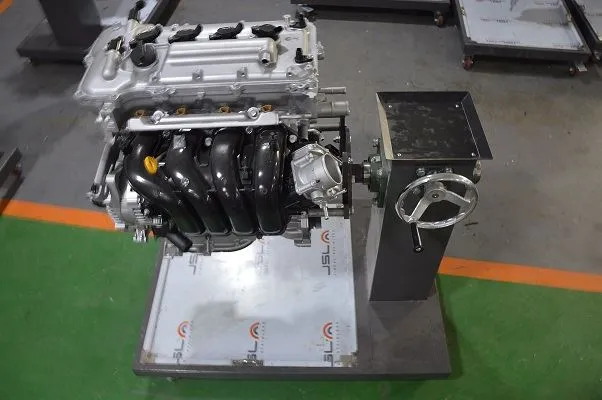

Noise Reduction: As mentioned earlier, the muffler plays a key role in reducing noise. But the overall design of the exhaust system also affects noise levels. We use acoustic engineering techniques to design exhaust systems that are not only quiet but also provide a realistic engine sound for the training experience.
Durability: Gasoline engine trainers are used in educational settings where they are likely to be used frequently. So, the exhaust system needs to be durable. We use high - quality materials, such as stainless steel, which can withstand the high temperatures and corrosive nature of exhaust gases.
Benefits of Our Gasoline Engine Trainers' Exhaust Systems
Our exhaust systems offer several benefits for educational institutions and students.
Enhanced Learning Experience: With different exhaust system designs available in our trainers, students can learn about the impact of exhaust design on engine performance, emissions, and noise. They can see firsthand how changing the exhaust system can affect the engine's operation.
Real - World Application: The exhaust systems in our trainers are designed to mimic real - world automotive engines. This means that students are learning skills and knowledge that are directly applicable in the automotive industry.
Safety: Our exhaust systems are designed with safety in mind. They are properly sealed to prevent the leakage of exhaust gases, which can be harmful. This ensures a safe learning environment for students.
Why Choose Us as Your Gasoline Engine Trainer Supplier
We've been in the business for a long time, and we've built a reputation for providing high - quality gasoline engine trainers. Our exhaust systems are just one part of the equation. We offer comprehensive training solutions, including detailed manuals, video tutorials, and technical support.
Our trainers are constantly updated to incorporate the latest technology and industry trends. Whether you're a school, a college, or a vocational training center, our gasoline engine trainers can meet your educational needs.
If you're interested in learning more about our products or have any questions about the exhaust system designs of our gasoline engine trainers, don't hesitate to reach out. We're here to help you with your training equipment needs and are ready to have some in - depth discussions about purchasing and customization.
References
- "Automotive Engine Design: Principles and Practice" by Charles Crolla
- "Internal Combustion Engine Fundamentals" by John Heywood
- Industry reports on automotive exhaust system technology


