

Let's talk about the maximum speed of a gasoline engine trainer. As a supplier of Gasoline Engine Trainers, I've had quite a few customers asking about this topic. It's not just a random question; the maximum speed is a crucial factor that can tell you a lot about the engine trainer's performance and its capabilities in educational settings or even in some research - related work.
First off, what exactly is a gasoline engine trainer? It's basically a device designed mostly for educational purposes. It helps students learn about how gasoline engines work, from the basic principles of combustion to the more complex aspects of engine management. These trainers are like a mini - version of a real - world gasoline engine, but they're set up in a way that allows easy access and study.
When it comes to the maximum speed of a gasoline engine trainer, several factors come into play. The design of the engine itself is one of the major ones. Think about it, engines come in different shapes and sizes, with different numbers of cylinders and configurations. A V6 engine, for example, differs significantly from a 4 - cylinder engine in terms of performance capabilities.
Our V6 Educational Car Petrol Engine Model is a great example. It's designed to mimic the performance characteristics of a real - world V6 gasoline engine. The V - shaped configuration of the cylinders allows for a more balanced power delivery, which can have an impact on the maximum achievable speed. In a well - tuned V6 engine trainer like this one, the cylinders work in harmony to produce a relatively high level of power. But that doesn't mean it can zoom off like a race car. These trainers are built for education, so their maximum speeds are more about demonstrating the engine's capabilities within a safe and controlled environment.
Another important aspect is the fuel - air mixture. For a gasoline engine to run efficiently and reach its maximum speed, the right amount of fuel and air needs to be mixed together. If there's too much fuel or too little air, the engine might not perform well, and its maximum speed will be affected. In our Automotive Technology Petrol Engine Training Equipment, students can learn how to adjust the fuel - air mixture and see how it directly influences the engine's speed. When the mixture is just right, the engine can burn the fuel more completely, releasing more energy and potentially increasing the speed.
The ignition system also plays a huge role. An accurate ignition timing is essential for the engine to run smoothly at high speeds. If the spark plugs fire at the wrong time, it can cause knocking or misfires, which not only reduces the engine's performance but can also damage it over time. Our Automotive Electronic Fuel Ignition Trainer Model helps students understand how the ignition system works and how to optimize it for better speed and performance.
But it's not just about the internal components; the load on the engine also affects its maximum speed. When the engine is under a heavy load, like when it's attached to a large generator or a high - torque device, it will have a harder time reaching its top speed. This is because it has to work harder to overcome the resistance. On the other hand, if the load is light, the engine can more easily increase its speed.
Now, you might be wondering what the typical maximum speed range of a gasoline engine trainer is. Well, it can vary widely depending on the type of engine and its design. Some smaller, basic engine trainers might have a maximum speed of around 1500 - 2000 revolutions per minute (RPM). These are usually the simpler models that are designed for introductory courses.
For more advanced models, like our high - end V6 engine trainer, the maximum speed can go up to 3000 - 4000 RPM. At these speeds, students can really get a feel for how a high - performance engine operates. They can observe things like the engine's power output at different speeds, the changes in the exhaust gases, and how the engine management system adjusts to maintain stability.
It's important to note that these are just general ranges, and the actual maximum speed can be fine - tuned. With proper maintenance, calibration, and adjustments, it's possible to push the engine trainer a bit further. For example, regularly cleaning the air filters and spark plugs can improve the engine's efficiency and potentially increase its top speed.
As a supplier, we understand that different educational institutions and research facilities have different needs. That's why we offer a wide range of gasoline engine trainers with varying capabilities. Whether you're a high - school looking for a basic model to introduce students to engine concepts or a university carrying out in - depth research on engine performance, we've got you covered.
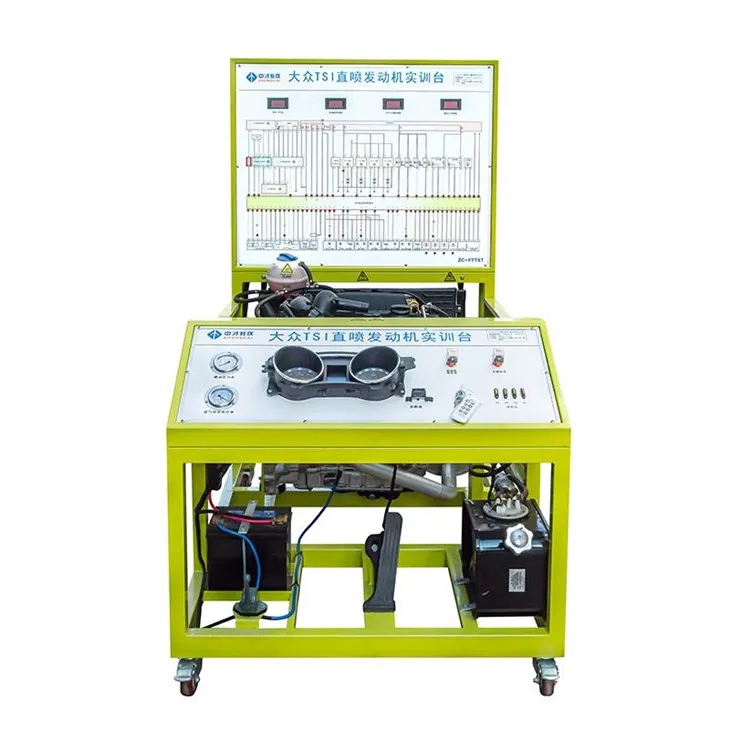

If you're interested in learning more about our gasoline engine trainers or want to discuss which model would be the best fit for your needs, we're here to help. Contact us for a detailed consultation and let's start a conversation about how our products can enhance your educational or research projects. We're always happy to provide support and guidance throughout the purchasing process.
References
- Automotive Engineering Handbook, various editions
- Textbooks on internal combustion engines from leading publishers


