

A Controller Area Network (CAN) bus trainer is an essential educational tool in the field of automotive engineering and electronics. As a CAN Bus Trainer supplier, I am excited to share in - depth knowledge about what a CAN bus trainer is, its significance, and the various types of products we offer.
Understanding the CAN Bus
Before delving into what a CAN bus trainer is, it's crucial to understand the CAN bus itself. The CAN bus is a robust vehicle bus standard designed to allow microcontrollers and devices to communicate with each other within a vehicle without a host computer. It was first developed in the 1980s by Robert Bosch GmbH for use in automobiles to reduce the amount of wiring and improve the reliability of communication between different components.
The CAN bus operates on a two - wire communication system, CAN High (CAN_H) and CAN Low (CAN_L). Data is transmitted as a series of electrical signals on these wires, and multiple nodes can be connected to the same bus. This decentralized communication system enables efficient data sharing among various automotive systems such as engine control units (ECUs), anti - lock braking systems (ABS), and airbag systems.
What is a CAN Bus Trainer?
A CAN bus trainer is a specialized piece of equipment that is used to teach and learn about the CAN bus technology. It typically consists of a set of components that mimic the real - world CAN bus network in a vehicle. These trainers are designed to provide hands - on experience with CAN bus communication protocols, message formatting, and network configuration.
The main components of a CAN bus trainer usually include:
- Microcontrollers or ECUs: These act as the nodes on the CAN bus network. They can be programmed to send and receive CAN messages, allowing users to understand how different nodes interact with each other.
- CAN Transceivers: These are responsible for converting the digital signals from the microcontrollers into electrical signals that can be transmitted over the CAN bus wires and vice versa.
- Display Units: To show the status of the CAN bus network, such as the messages being transmitted, error flags, and network statistics.
- Power Supply: To provide the necessary electrical power for all the components of the trainer.
Significance of CAN Bus Trainers
- Educational Purposes: In educational institutions, CAN bus trainers are used to teach students about automotive electronics and communication systems. They provide a practical way for students to understand theoretical concepts such as CAN message arbitration, bit timing, and network topology.
- Professional Training: For automotive technicians and engineers, CAN bus trainers are used for professional development. They help in troubleshooting CAN bus - related problems in vehicles, understanding the operation of different ECUs, and learning about the latest CAN bus standards.
- Research and Development: In the automotive industry, CAN bus trainers are used for research and development purposes. They allow engineers to test new CAN bus - based systems, develop new communication protocols, and evaluate the performance of different components.
Types of CAN Bus Trainers We Offer
As a CAN Bus Trainer supplier, we have a wide range of products to meet different educational and training needs.
Automotive Diesel Common Rail Simulator On Board
Our Automotive Diesel Common Rail Simulator On Board is a state - of - the - art CAN bus trainer. It is specifically designed to teach students about the operation of diesel engines with common rail fuel injection systems. This trainer includes a real - time simulator that mimics the behavior of a diesel engine's ECU and other related components. Students can learn about how the CAN bus is used to control the fuel injection process, monitor engine parameters, and diagnose faults.
Can Bus Training Equipment
Our Can Bus Training Equipment is a comprehensive set of tools for learning about CAN bus technology. It includes a variety of microcontrollers, CAN transceivers, and display units. This equipment is suitable for both beginners and advanced learners. Beginners can use it to understand the basic concepts of CAN bus communication, while advanced learners can use it for more complex tasks such as developing custom CAN applications and analyzing network performance.
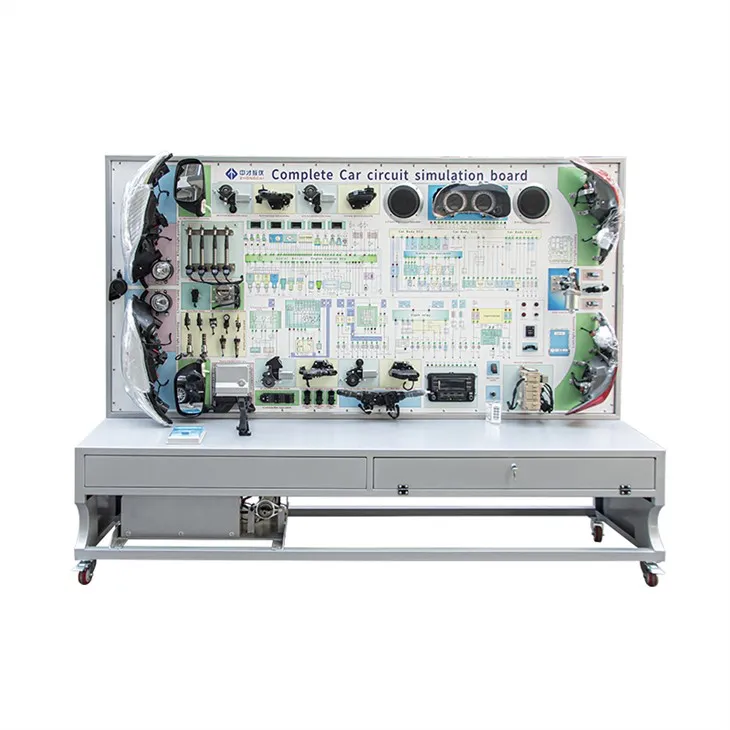

Corolla Whole Vehicle Electrical System Training Platform
The Corolla Whole Vehicle Electrical System Training Platform is a unique CAN bus trainer that focuses on the electrical system of a Toyota Corolla. It provides a detailed model of the Corolla's electrical network, including all the major ECUs and their interconnections. Students can learn about how the CAN bus is used to integrate different electrical systems in a real - world vehicle, such as the lighting system, climate control system, and entertainment system.
Technical Features of Our CAN Bus Trainers
- Modular Design: Our trainers are designed with a modular approach, which means that different components can be easily added or removed. This allows for customization according to the specific training requirements.
- User - Friendly Interface: All our trainers come with a user - friendly interface that makes it easy for users to operate and configure the CAN bus network. The display units provide clear and detailed information about the network status.
- Compatibility: Our trainers are compatible with a wide range of programming languages and development tools. This enables users to write their own CAN bus applications and test them on the trainer.
How to Use a CAN Bus Trainer
Using a CAN bus trainer typically involves the following steps:
- Assembly: First, assemble the different components of the trainer according to the provided instructions. Make sure all the connections are secure.
- Power On: Connect the power supply to the trainer and turn it on. Check the status of the display unit to ensure that the trainer is functioning properly.
- Configuration: Configure the CAN bus network parameters such as bit rate, node addresses, and message filters. This can usually be done through a software interface.
- Testing: Send and receive CAN messages using the microcontrollers or ECUs on the trainer. Monitor the messages on the display unit and analyze the network performance.
Contact Us for Purchase and洽谈
If you are interested in our CAN bus trainers for educational, professional training, or research purposes, we invite you to contact us for purchase and further discussion. Our team of experts is ready to assist you in choosing the right product for your needs and providing any technical support you may require.
References
- Bosch, R. (1999). CAN Specification 2.0. Robert Bosch GmbH.
- Automotive Engineering Handbook. Society of Automotive Engineers (SAE).


