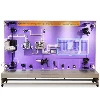
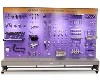
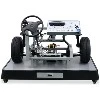
Programmable controller (PLC) laboratory construction program
PLC Training Room Introduction
Programmable controller (also known as PC or PLC) is a new type of general-purpose industrial control device based on microprocessor and integrated with computer automatic control and communication technologies, which is widely used in various industries such as steel, petroleum, chemical, electric power, building materials, machinery manufacturing, automobile, light industry, transportation, environmental protection and culture and entertainment.
Programmable controller (also called PLC) is a new type of general-purpose industrial control device based on microprocessor and integrated with computer automatic control and communication technologies, which is a typical automatic control training platform in the field of modern industrial automation, such as programmable controller application technology, inverter application technology, touch screen application technology, industrial network communication application technology, etc. The practical training device fully considers the current situation and development trend of domestic practical training education equipment system, fully considers the characteristics of students and trainers, and emphasizes highlighting the hands-on ability of students and trainers. The training room supports open experiment teaching and design experiment development and network control, which is especially suitable for today's education teaching and experiment design and engineering technology training. It is used for teaching and skills training of "Programmable Controller Technology", "Electrical and PLC Control Technology", "PLC and its Application", "Inverter Speed Control Technology" and other courses of electromechanical and non-electromechanical majors.
PLC practical training room undertakes the following practical training projects.
Inverter function parameter setting and operation; external terminal pointing control; inverter control motor forward and reverse; multi-segment speed selection inverter speed control; inverter stepless speed control; inverter speed control based on external analog (voltage/current) control mode; instantaneous power failure start control; PLC, inverter speed control; PLC control inverter external terminal motor forward and reverse; PLC control inverter external terminal motor Running time control; PLC digital control method based on multi-step speed; motor control; stepper motor; automatic feeding and loading system; automatic water level control of water tower; traffic light self-control and manual control; a variety of liquid mixing; self-control molding machine; self-control rolling machine; mail sorting machine; tower of light; three-story elevator control; machining center tool magazine control; robotic assembly and handling assembly line; vending machine simulation experiment; four-section conveyor belt; assembly assembly line; musical fountain; PLC robber; flash control system module.
Programmable controller for short - PLC is a new type of industrial control device based on microprocessor, integrated with the development of computer technology, automatic control technology and communication technology. It has the advantages of simple structure, easy programming and high reliability, and has been widely used in the automatic control of industrial processes and positions. According to statistics, programmable controller is one of the most used devices in industrial automation devices. Experts believe that programmable controllers will become the main means of industrial control and important infrastructure equipment in the future PLC, robotics and CAD/CAM will become the three pillars of industrial production.
PLC is based on the relay control logic, and 3C (Computer, Control, Communication) technology combined with the continuous development of perfect. It has been developed from small-scale stand-alone sequential control to all control fields including process control, position control and other occasions. Automation systems used in various types of PLC, some are centrally installed in the control room, some are scattered in the production site of the individual equipment, although they are mostly in the strong electrical circuits and strong electrical equipment formed by the harsh electromagnetic environment, but PLC is designed specifically for the industrial production environment and the design of control devices, in the design and manufacturing process using multi-level anti-interference and selected components measures, so Has a strong ability to adapt to the harsh industrial environment, operational stability and high reliability, so generally do not need to take any special measures can be used directly in the industrial environment.
High reliability is the key performance of electrical control equipment. PLC due to the use of modern large-scale integrated circuit technology, the use of strict manufacturing process, the internal circuit to take advanced anti-interference technology, has a high degree of reliability. For example, the average failure-free time of the F series PLC produced by Mitsubishi is as high as 300,000 hours. Some of the use of redundant CPU's PLC's average trouble-free work time is longer. From the PLC circuit outside the machine, the use of PLC control system, and the same size of the relay contactor system, compared to the electrical wiring and switch contacts have been reduced to hundreds or even thousands of points, the failure is greatly reduced. In addition, PLC with hardware failure self-detection function, when a failure can be issued in a timely manner alarm information. In the application software, the application can also be programmed into the peripheral device fault self-diagnostic procedures, so that the system in addition to the PLC circuit and equipment also obtains fault self-diagnostic protection. In this way, the whole system has a very high reliability is not surprising.
For a long time, plc has always been in the main battlefield of industrial control automation, providing very reliable control solutions for a wide range of automation control equipment, and dcs and industrial pc to form a three-pronged trend. At the same time, plc is also suffering from the impact of other technology products, especially the impact of the industrial pc.
At present, the world's plc manufacturers about 200, producing more than 300 kinds of products. Domestic plc market is still dominated by foreign products, such as siemens, modicon, a-b, omron, mitsubishi, ge products. After years of development, there are about thirty domestic plc manufacturers, but they have not formed a sizeable production capacity and brand-name products, it can be said that plc in China has not yet formed manufacturing industrialization. In terms of plc applications, China is very active, and the application of the industry is also very wide. Experts estimate that the domestic market sales of plc in 2000 was 15(200,000 sets (of which imports accounted for about 90%), about 2.5(3.5 billion RMB, with an annual growth rate of about 12%. The national plc demand is expected to reach about 250,000 sets by 2005, or about 3.5(4.5 billion yuan. The plc market also reflects the state of manufacturing worldwide, which has declined substantially since 2000. However, according to automation research corp, the plc market will recover despite the global economic downturn, with the global plc market estimated at $7.6 billion in 2000 and will return to $7.6 billion by the end of 2005 and continue to grow slightly.
Miniaturization, networking, pc-ization and openness are the main directions of plc's future development. In the early days of plc-based automation, plc's were large and expensive. But in the last few years, miniature plc (less than 32 i/o) have emerged with prices of a few hundred euros. With the further improvement and development of soft plc (soft plc) control configuration software, the installation of soft plc configuration software and pc-based control market share will gradually grow.
Currently, one of the biggest trends in the field of process control is the expansion of ethernet technology, and plc is no exception. More and more plc suppliers are now offering ethernet interfaces. It can be believed that plc will continue to move in the direction of open control system, especially the control system based on industrial pc.
At present, PLC has been widely used at home and abroad in various industries such as steel, petroleum, chemical, electric power, building materials, machinery manufacturing, automotive, light textile, transportation, environmental protection and culture and entertainment, etc. The use can be broadly summarized as follows:
Switching logic control: This is the most basic and extensive application area of PLC, which replaces the traditional relay circuit to achieve logic control, sequence control, can be used for single equipment control, but also for multi-machine group control and automated assembly line. Such as injection molding machines, printing machines, stapling machinery, combined machine tools, grinding machines, packaging lines, electroplating lines, etc.; Analog control: In the industrial production process, there are many continuously changing quantities, such as temperature, pressure, flow, liquid level and speed, etc. are analog quantities. In order to make the programmable controller deal with analog quantity, it must realize A/D conversion and D/A conversion between analog quantity (Analog) and digital quantity (Digital), and PLC manufacturers produce supporting A/D and D/A conversion modules to make the programmable controller used for analog control; motion control: PLC can be used for circular motion or linear motion control. From the control mechanism configuration, early used directly for switching I/O modules connected to position sensors and actuators, now generally use a dedicated motion control module. Such as single-axis or multi-axis position control modules that can drive stepper motors or servo motors. The products of the world's major PLC manufacturers almost all have motion control functions, widely used in a variety of machinery, machine tools, robots, elevators and other occasions; process control: process control refers to the closed-loop control of temperature, pressure, flow and other analog quantities. As an industrial control computer, PLC can prepare a variety of control algorithm programs to complete the closed-loop control.
PID regulation is generally used in closed-loop control systems more regulation methods. Large and medium-sized PLC have PID module, many small PLC also has this function module. pid processing is generally running a special PID subroutine. Process control in metallurgy, chemical industry, heat treatment, boiler control and other occasions have a very wide range of applications; data processing: modern PLC with mathematical operations (including matrix operations, functional operations, logic operations), data transfer, data conversion, sorting, table look-up, bit manipulation and other functions, can complete the data collection, analysis and processing. These data can be compared with the reference values stored in the memory, to complete certain control operations, but also can use the communication function to transfer to other intelligent devices, or they will be printed and tabulated. Data processing is generally used in large control systems, such as uncontrolled flexible manufacturing systems; can also be used in process control systems, such as paper, metallurgy, food industry in some large control systems; communication and networking: PLC communication contains PLC communication and PLC communication with other intelligent devices. With the development of computer control, factory automation network is developing rapidly, the PLC manufacturers attach great importance to the communication function of PLC, have launched their own network system. The new production of PLCs have communication interfaces, communication is very convenient.