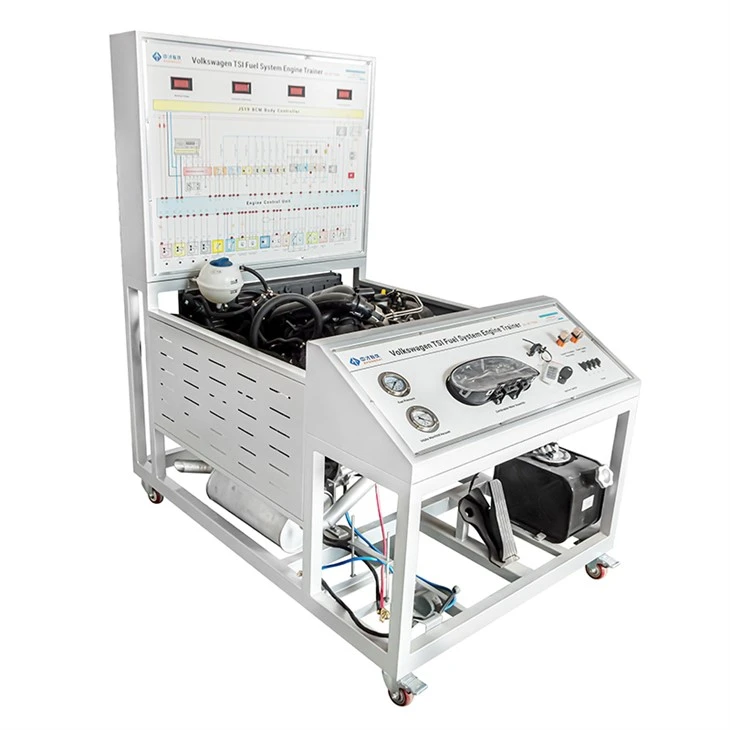
Hey there! As a supplier of Petrol Engine Trainers, I often get asked about the power output of these trainers. It's a crucial aspect that many folks in the automotive training field care about, so I thought I'd dive into it in this blog post.
First off, let's understand what a petrol engine trainer is. It's a piece of equipment designed to give hands - on experience to students, mechanics - in - training, and anyone interested in learning about petrol engines. These trainers mimic the real - world operation of a petrol engine, allowing users to understand how different components work together, troubleshoot issues, and gain practical skills.
Now, onto the power output. The power output of a petrol engine trainer can vary quite a bit, and it depends on several factors. One of the main factors is the size and design of the engine used in the trainer. Just like in real cars, smaller engines generally have lower power outputs compared to larger ones.
Typically, petrol engine trainers can have power outputs ranging from a few horsepower to around 50 horsepower. For basic training setups that are mainly used for demonstrating fundamental engine concepts like the four - stroke cycle, ignition systems, and fuel injection, a lower - power engine, say around 5 - 10 horsepower, might be sufficient. These trainers are great for introductory courses where students are just getting their feet wet in the world of petrol engines.
On the other hand, if you're looking for a trainer that can simulate more real - world driving conditions, such as load variations and higher - speed operations, you'll need a trainer with a higher power output. Trainers with 20 - 50 horsepower can provide a more accurate representation of how a real - life petrol engine behaves under different loads. This is especially useful for advanced training programs where students are learning about engine tuning, performance optimization, and diagnosing complex engine problems.
Another factor that affects the power output is the type of fuel and the engine's efficiency. Modern petrol engine trainers are designed to be as efficient as possible, but the quality of the fuel used can still have an impact. High - quality fuels with the right octane rating can help the engine run more smoothly and potentially increase its power output.
The engine's compression ratio also plays a significant role. A higher compression ratio generally leads to more power, but it also requires a higher - octane fuel to prevent knocking. Petrol engine trainers are often designed with adjustable compression ratios to allow students to understand how this parameter affects engine performance.
Let's talk about the applications of different power - output petrol engine trainers. For schools and vocational training centers that are just starting their automotive programs, a lower - power trainer is a great choice. It's more affordable, easier to maintain, and still provides a solid foundation for students to learn the basics. You can check out our Automotive Laboratory Training Equipment Engine Technology for some great options in this category.
For professional training facilities and automotive repair shops that want to train their technicians on more advanced skills, a higher - power trainer is the way to go. These trainers can handle more complex operations and give technicians a better understanding of how real - world engines perform. Our Control Panel For Automobile Petrol Engine Injection Trainer is a great example of a trainer that can offer more advanced training features.
If you're specifically interested in repair skill training, our Live Petrol Engine For Repair Skill Training is an excellent option. It uses a real - life petrol engine, which gives trainees a hands - on experience of working on an actual engine, including tasks like disassembly, assembly, and troubleshooting.
When it comes to choosing the right power output for your petrol engine trainer, you need to consider your training goals, budget, and available space. If you have a limited budget and space, a lower - power trainer might be the best fit. But if you're aiming for comprehensive and advanced training, investing in a higher - power trainer is worth it in the long run.
We understand that every training facility has different needs, and that's why we offer a wide range of petrol engine trainers with various power outputs. Whether you're a small school or a large professional training center, we've got a solution for you.
If you're interested in learning more about our petrol engine trainers or want to discuss which power output would be best for your specific needs, don't hesitate to reach out. We're here to help you make the right choice and ensure that your training program is a success.
In conclusion, the power output of a petrol engine trainer is a key factor that can significantly impact the quality of your training program. By understanding the different factors that affect power output and choosing the right trainer for your needs, you can provide your students or technicians with a top - notch learning experience.
References:
- Automotive engineering textbooks on engine design and performance
- Industry reports on automotive training equipment
So, if you're ready to take your automotive training to the next level, get in touch with us today and let's start this journey together!