

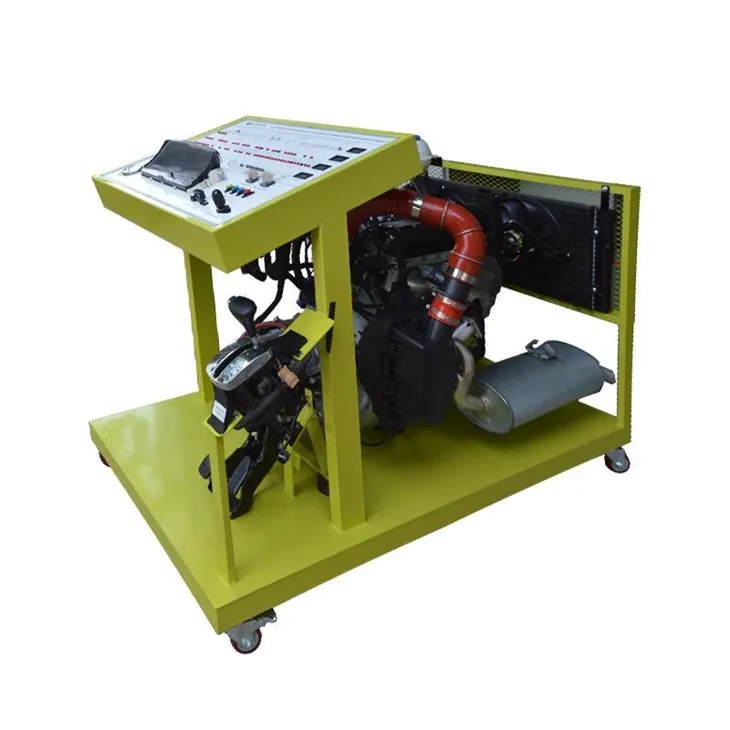
As a supplier of Petrol Engine Trainer Equipment, I've witnessed firsthand the growing importance of understanding the exhaust emission situation of these devices. In the realm of automotive education, petrol engine trainer equipment plays a crucial role in equipping students with practical knowledge and skills. However, the exhaust emissions from such equipment are a topic that demands careful consideration, both from an environmental and educational perspective.
The Basics of Exhaust Emissions from Petrol Engine Trainer Equipment
Petrol engine trainer equipment operates on the same fundamental principles as real - world petrol engines. When a petrol engine burns fuel, a series of chemical reactions occur within the combustion chamber. The primary components of petrol are hydrocarbons, and when they react with oxygen during combustion, the ideal outcome is the production of carbon dioxide (CO₂) and water vapor (H₂O). But in reality, the combustion process is far from perfect.
One of the most significant pollutants emitted by petrol engines is carbon monoxide (CO). This is a colorless and odorless gas that forms when there is incomplete combustion of petrol. Inadequate oxygen supply, improper fuel - air mixture, or engine malfunctions can all lead to increased CO emissions. CO is extremely harmful to human health as it binds to hemoglobin in the blood, reducing its ability to carry oxygen.
Nitrogen oxides (NOₓ) are another group of pollutants produced in petrol engine trainer equipment. At high temperatures in the combustion chamber, nitrogen and oxygen from the air react to form various nitrogen oxides, mainly nitric oxide (NO) and nitrogen dioxide (NO₂). NOₓ emissions contribute to the formation of smog, acid rain, and can also cause respiratory problems in humans.
Hydrocarbons (HC) are unburned or partially burned fuel molecules that are released into the atmosphere. They can react with NOₓ in the presence of sunlight to form ground - level ozone, which is a major component of smog. Ozone can cause eye irritation, respiratory issues, and damage to plants.
Particulate matter (PM) is also emitted, although in relatively smaller quantities compared to full - scale automotive engines. PM consists of tiny solid or liquid particles that can be inhaled deep into the lungs, causing health problems such as lung cancer, heart disease, and respiratory infections.
Factors Affecting Exhaust Emissions in Petrol Engine Trainer Equipment
Engine Design and Condition
The design of the petrol engine in the trainer equipment significantly impacts exhaust emissions. Older engine designs may not be as efficient in terms of combustion, leading to higher emissions of CO, HC, and NOₓ. For example, engines with a simple carburetor system may have more difficulty in maintaining the optimal fuel - air mixture compared to engines with modern fuel injection systems.
The condition of the engine is equally important. Worn - out spark plugs, dirty air filters, or malfunctioning sensors can all disrupt the normal combustion process. A faulty oxygen sensor, for instance, may not accurately measure the oxygen content in the exhaust, causing the engine control unit to adjust the fuel - air mixture incorrectly and increase emissions.
Fuel Quality
The quality of the petrol used in the trainer equipment can have a substantial effect on exhaust emissions. Low - quality fuel may contain impurities such as sulfur, which can increase the formation of sulfur dioxide (SO₂) during combustion. Additionally, the octane rating of the fuel can influence combustion efficiency. If the octane rating is too low for the engine's requirements, it can lead to knocking, which in turn can increase emissions.
Operating Conditions
The way the petrol engine trainer equipment is operated also affects exhaust emissions. Idling for extended periods can lead to higher CO and HC emissions as the engine is not operating under optimal conditions. Rapid acceleration and deceleration can also cause spikes in NOₓ and HC emissions. On the other hand, maintaining a steady speed and avoiding aggressive driving patterns can help reduce emissions.
Measuring and Controlling Exhaust Emissions
Emission Measurement
To understand the exhaust emission situation of petrol engine trainer equipment, accurate measurement is essential. There are various emission measurement techniques and devices available. One common method is the use of exhaust gas analyzers. These devices can measure the concentrations of CO, CO₂, HC, NOₓ, and oxygen in the exhaust gas. By analyzing these measurements, it is possible to assess the engine's combustion efficiency and identify potential emission problems.
Another approach is the use of particulate matter sensors, which can detect and measure the amount of PM in the exhaust. These sensors are particularly useful for monitoring the emission of fine particles that can have a significant impact on air quality.

Emission Control Technologies
There are several technologies available to control exhaust emissions in petrol engine trainer equipment. One of the most common is the catalytic converter. A catalytic converter contains catalysts that promote chemical reactions to convert harmful pollutants into less harmful substances. For example, it can convert CO into CO₂, HC into CO₂ and H₂O, and NOₓ into nitrogen and oxygen.
Exhaust gas recirculation (EGR) is another technique used to reduce NOₓ emissions. EGR works by recirculating a portion of the exhaust gas back into the engine's intake manifold. This reduces the peak combustion temperature, thereby reducing the formation of NOₓ.
Modern petrol engine trainer equipment may also be equipped with advanced engine management systems that continuously monitor and adjust the engine's operating parameters to optimize combustion and reduce emissions. These systems use sensors to gather data on various engine conditions and make real - time adjustments to the fuel - air mixture, ignition timing, and other factors.
The Importance of Understanding Exhaust Emissions in Automotive Education
In the context of automotive education, understanding the exhaust emission situation of petrol engine trainer equipment is crucial for several reasons. Firstly, it helps students develop a comprehensive understanding of how engines work and the environmental impact of their operation. By learning about exhaust emissions, students can appreciate the importance of engine efficiency and emission control technologies.
Secondly, it prepares students for real - world automotive scenarios. In the automotive industry, emission regulations are becoming increasingly strict. By gaining hands - on experience with emission measurement and control in the training environment, students will be better equipped to diagnose and repair emission - related problems in actual vehicles.
Our Offerings in Petrol Engine Trainer Equipment
As a supplier, we are committed to providing high - quality petrol engine trainer equipment that not only meets educational needs but also adheres to environmental standards. Our Automotive Training Boards Education Equipment For Schools offers students a realistic hands - on experience with petrol engines. It is designed with modern engine technologies to ensure efficient combustion and reduced exhaust emissions.
Our Gasoline Engine Electronic Control System Training Panel allows students to study the electronic control systems of petrol engines, which play a vital role in optimizing combustion and reducing emissions. By understanding these systems, students can learn how to adjust engine parameters to minimize exhaust pollutants.
We also offer Automotive Educational Auto Training School Equipment that includes advanced emission measurement and control features. These features enable students to accurately measure exhaust emissions and experiment with different emission control techniques.
Conclusion and Call to Action
In conclusion, the exhaust emission situation of petrol engine trainer equipment is a complex but important topic. By understanding the factors affecting emissions, measuring them accurately, and implementing appropriate control technologies, we can ensure that these training devices are both educational and environmentally friendly.
If you are an educational institution, training center, or an individual interested in high - quality petrol engine trainer equipment, we invite you to contact us for procurement and further discussions. Our team of experts is ready to provide you with detailed information and support to meet your specific needs.
References
- Heywood, J. B. (1988). Internal Combustion Engine Fundamentals. McGraw - Hill.
- Turner, J. D. (2007). Automotive Engine Design. Elsevier.
- SAE International. (2019). SAE Handbook: Volume 1 - Automotive Chassis and Powertrain Systems. SAE International.


